
A Shifting Approach to Early Learning: Building Cooperation Through Connection & Play
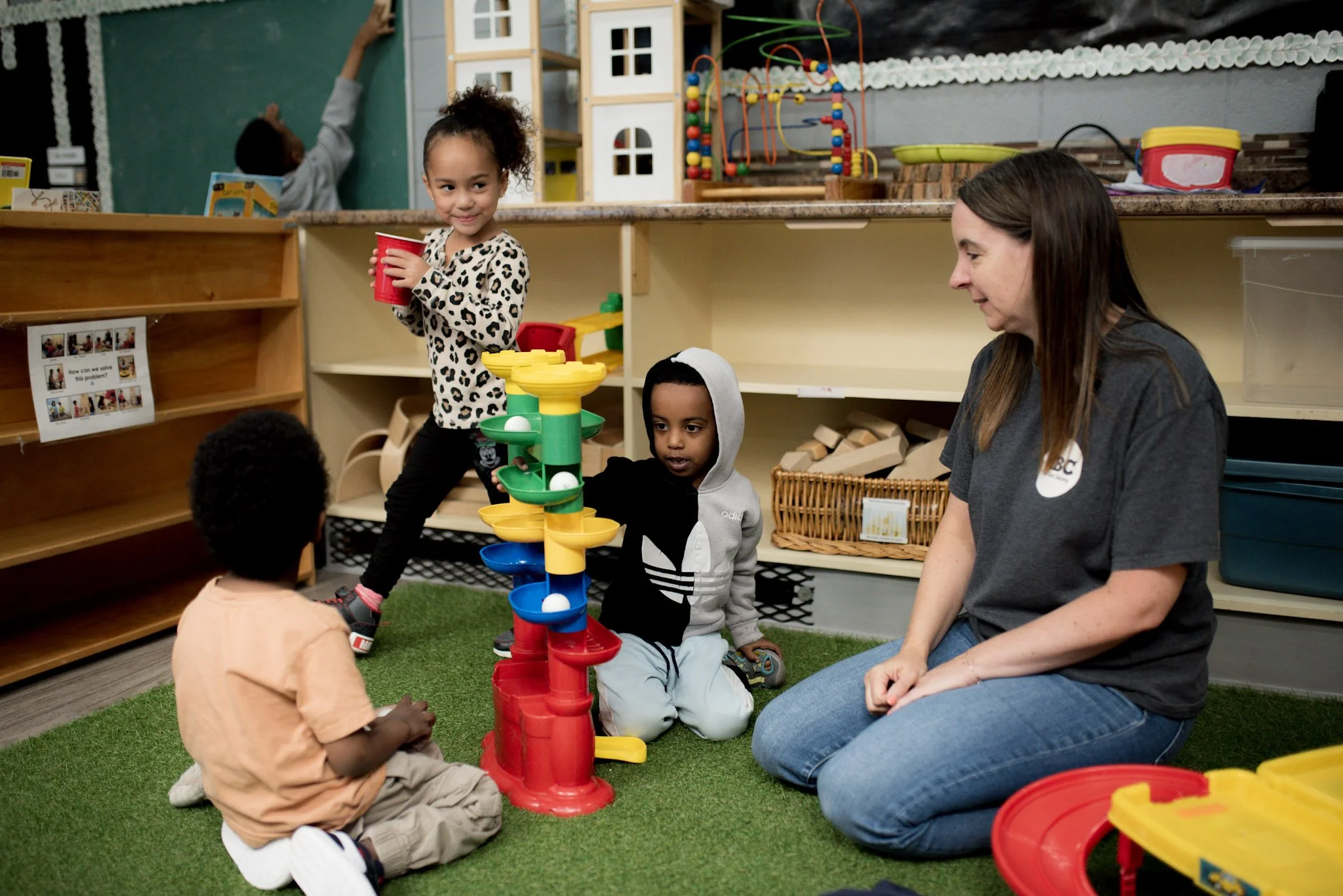
ABC Head Start Classroom Environment
At ABC Head Start, our work is grounded in the belief that children thrive in environments where they feel safe, connected, and understood. Every interaction, every routine, and every relationship contributes to how a child experiences learning—not just what they learn, but how they come to engage with the world around them.
One of the ongoing reflections in early childhood education is how we, as adults, support children’s participation. Traditionally, many environments have relied on compliance-based approaches—where success is measured by how quickly or consistently a child follows directions, completes tasks, or meets expectations. While this can create structure, it can also lead to repeated prompting, power struggles, and moments where adults are carrying most of the interaction (Gorgan & Kodak, 2019; English, 2022).
At ABC Head Start, we are continuing to shift that perspective toward cooperation.
This shift is not about changing what we expect from children—it’s about changing how we show up in those moments.
When we move away from a compliance-based approach, we often begin to see meaningful changes. There is less resistance in moments that may have previously led to “stop doing that” battles. Children show more willingness to participate in routines and activities. Emotional regulation becomes more supported, and interactions feel less reactive. Most importantly, the connection between adult and child strengthens, creating a foundation for ongoing learning and engagement.
Cooperation looks different because it is rooted in relationship. It is not driven by pressure or urgency, but by trust and shared participation. When children feel connected to the adults around them and supported in their regulation, their motivation begins to come from within rather than from external prompts. Over time, this leads to deeper engagement, longer participation, and greater independence across their day (Williford et al., 2013; Alamos & Williford, 2019; Coelho et al., 2018; Zhao et al., 2024).
This shift is especially important when supporting neurodivergent children. Compliance-based approaches can unintentionally increase stress, leading to dysregulation, fight-flight-freeze responses, or masking behaviours that can be emotionally exhausting. When we begin to view resistance as communication rather than defiance, it changes how we respond. Instead of asking children to meet us where we are, we begin to meet them where they are.
In practice, this shift often shows up in small but meaningful changes to how we interact.
Instead of relying on direct commands, asking multiple questions, or repeating prompts, we can begin to adjust our language and approach in ways that invite participation.
In practice, this shift often shows up in small but meaningful changes to how we interact.
Instead of relying on direct commands, asking multiple questions, or repeating prompts, we can begin to adjust our language and approach in ways that invite participation.
Declarative language is one of these shifts. Rather than telling a child exactly what to do, we might make an observation, a comment, or a wondering. This reduces pressure while still guiding the expectation and opens the door for the child to engage, rather than requiring immediate compliance.
This might sound like:
“I notice the toys are still on the floor.”
“I wonder where these pieces belong.”
“I see a spot ready for you.”
These small shifts in language can make a significant difference. They keep the expectation clear, while creating space for the child to participate in a way that feels more collaborative than directive.
Offering controlled choices is another way to support cooperation. When a child is given two clear, acceptable options—such as how they move to the carpet or which task they begin with—they experience a sense of autonomy within a structured environment. This can reduce resistance and build trust over time.
Play also becomes a powerful tool in these moments.
Play is often seen as separate from structured routines, but it is one of the most effective ways to support cooperation and regulation. Research shows that play supports the development of self-regulation, impulse control, and executive functioning, and that children are often more able to manage their behaviour in play-based contexts than in non-play situations (Bodrova & Leong, 2018; Colliver et al., 2021).
In the classroom, this might look like turning a transition into a shared game. Instead of asking children to line up, they may be invited to move like animals, freeze when music stops, or follow a peer leader to the next activity. The expectation remains the same, but the experience shifts. What was once a moment of resistance can become a moment of connection and engagement.
Over time, these small changes have a cumulative effect.
Participation becomes more natural. Adults are no longer needing to repeat directions or manage ongoing power struggles. Children begin to take a more active role in their engagement, not because they are being required to, but because they feel ready and able to do so.
This work is not about removing structure or expectations. Those remain an important part of early learning environments. Rather, it is about how we support children in reaching them.
When participation is driven by pressure, adults carry the workload. When it is built through connection, regulation, and play, children begin to carry it with us.
And in those shared moments—where a child feels safe enough to engage, supported enough to regulate, and confident enough to participate—we see the foundations of independence, emotional well-being, and lifelong learning begin to grow.
Sources:
Alamos, P., & Williford, A. P. (2019). Exploring dyadic teacher–child interactions, emotional security, and task engagement in preschool children displaying externalizing behaviors. Social Development, 29(1), 339–355. https://doi.org/10.1111/sode.12403
Bodrova, E., & Leong, D. J. (2018). Tools of the Mind: the Vygotskian-Based Early Childhood Program. Journal of Cognitive Education and Psychology, 17(3), 223–237. https://doi.org/10.1891/1945-8959.17.3.223
Coelho, V., Cadima, J., Pinto, A. I., & Guimarães, C. (2018). Self-regulation, engagement, and developmental functioning in preschool-aged children. Journal of Early Intervention, 41(2), 105–124. https://doi.org/10.1177/1053815118810238
Colliver, Y., Harrison, L. J., Brown, J. E., & Humburg, P. (2021). Free play predicts self-regulation years later. Early Childhood Research Quarterly, 59, 148–161. https://doi.org/10.1016/j.ecresq.2021.11.011
English, A. (2022). Engagement and compliance in education today. Learning Research and Practice, 8(2), 139–147. https://doi.org/10.1080/23735082.2022.2085771
Gorgan, E. M., & Kodak, T. (2019). Comparison of interventions to treat prompt dependence. Journal of Applied Behavior Analysis, 52(4), 1049–1063. https://doi.org/10.1002/jaba.638
Williford, A. P., Whittaker, J. E. V., Vitiello, V. E., & Downer, J. T. (2013). Children’s engagement and self-regulation. Early Education and Development, 24(2), 162–187. https://doi.org/10.1080/10409289.2011.628270
Zhao, H., Sharp, K. L., & Malkus, A. J. (2023). Predictors of preschoolers’ classroom engagement. Early Child Development and Care, 194(1), 58–71. https://doi.org/10.1080/03004430.2023.2277132