
Celebrating Neurodivergent Strengths
By April MacDonald Killins
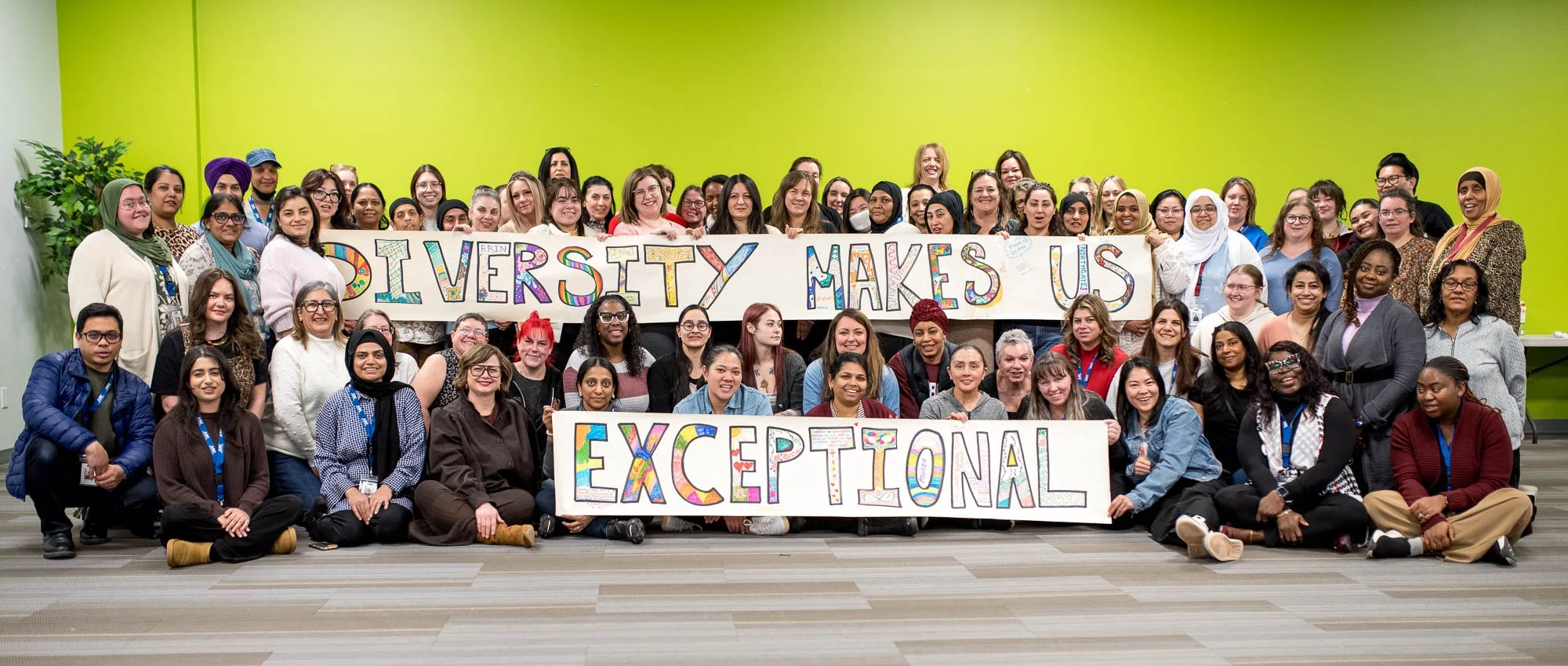
Neurodiversity Week invites us to celebrate the many ways young minds grow, learn, communicate, and connect. In the early years (birth to age five), development is rapid, complex, and deeply individual. Neurodiversity reminds us that there is no single “right” way for a child to meet milestones, express themselves, or engage with the world. At ABC Head Start, we celebrate everyone’s unique strengths, perspectives, and ways of experiencing the world. By creating inclusive, supportive environments and recognizing the diverse needs of every child, we help children build confidence, develop their abilities, and feel a true sense of belonging as they begin their learning journey.
“Neurodivergence in early childhood is not something to fear or rush to correct. It is a natural variation in human development. ”
There are many labels under the umbrella of “neurodivergence” such as ADHD, autism, dyslexia, and others. These diagnoses pathologize behaviours and responses that often emerge from sensory overload, unmet needs, or environments not designed for diverse learners. When we move away from pathology and take a strengths based, neurodivergent affirming approach in the earliest years, we lay the foundation for confidence, autonomy, and lifelong wellbeing (Graf-Kurtulus & Gelo, 2024; Izuno-Garcia, 2023)
Strengths of Neurodivergent Thinking in Children Ages 0–5
At ABC Head Start, our mission is to help children harness their superpowers, conquer hardships, and live their best life. A big part of learning to thrive is learning how to harness our strengths in pursuit of our goals. It is especially important to consciously teach this skill to neurodivergent children who will face a world of skepticism and prejudice. It is essential for them to understand their unique strengths and learn to advocate for the conditions that help them succeed.
Neurodivergent strengths often begin to show very early in life. While each child is unique, many neurodivergent young children demonstrate qualities that, when supported, can become powerful lifelong strengths.
Some children show deep focus and curiosity, becoming fully absorbed in activities, objects, or topics that capture their interest. This kind of focus can support early problemsolving, persistence, and mastery when environments allow children to explore at their own pace.
Others demonstrate advanced pattern recognition, noticing details, routines, or changes in their environment that adults may miss. This can support early learning, memory, and understanding of systems—even in preverbal children.
Many neurodivergent young children express themselves through movement, gesture, sound, or play, rather than through spoken language alone. These communication differences are not deficits; they are alternative and valid ways of connecting. When adults respond with curiosity rather than correction, children learn that their communication is meaningful.
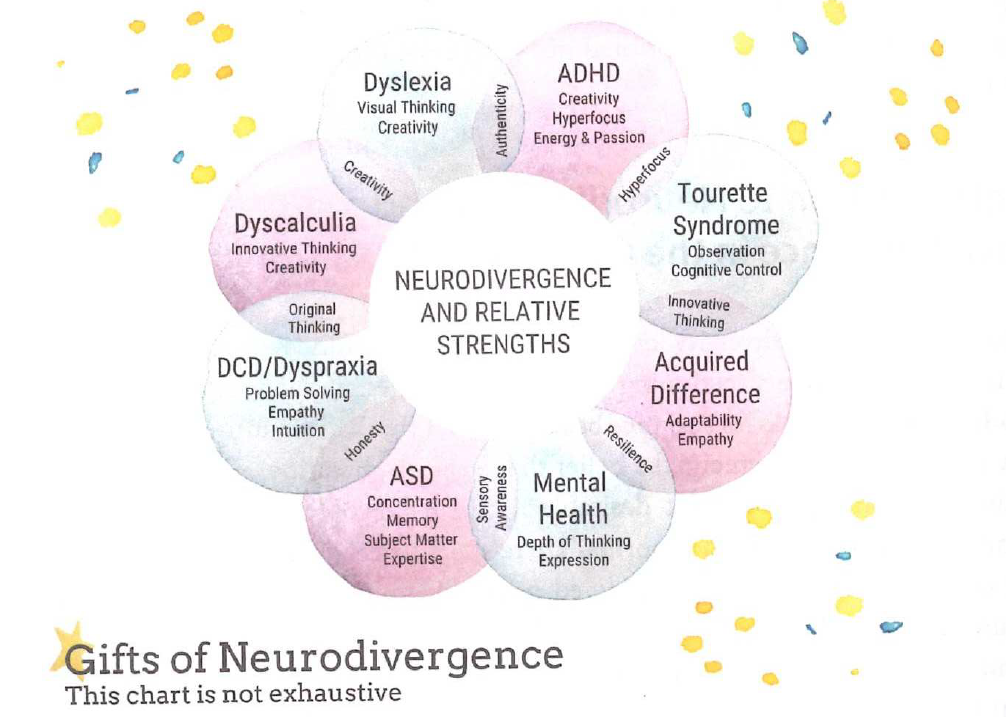
Creativity is another hallmark of neurodivergent thinking in early childhood. This may appear as unique play styles, imaginative problem-solving, or unconventional approaches to tasks. These children often think outside of expected patterns, offering new perspectives even in the earliest years.
Perhaps most importantly, neurodivergent children benefit from adults who understand that regulation comes before expectation.
Sensory processing differences, emotional intensity, and varying energy levels are not behavioural problems—they are signals about what a child’s nervous system needs.
The image (pictured right) shows relative strengths often observed and associated with different diagnoses (Killins, 2024).
Why Neurodivergent‑Affirming Practice Matters in Early Childhood Services
Early childhood is a critical window for shaping how children see themselves and how families experience support systems.
Neurodivergent‑affirming early intervention focuses on:
Building regulation and safety before skill acquisition
Honouring all forms of communication
Supporting development without erasing identity
Partnering with families as experts on their child
Professionals who are neurodivergent themselves, or who are raising neurodivergent children, often bring an added layer of insight. They are more likely to recognize subtle signs of overload, understand the emotional impact of early labeling, and advocate for supports that feel respectful rather than intrusive.
Lived experience matters, particularly when supporting our youngest learners who often can’t communicate the reasons behind their emotions and behaviour. Neurodivergent adults can bring a depth of empathy and understanding gained only through personal and emotional memory. They can draw on those memories to transform the way preverbal children are understood and that understanding can bridge theory and practice.
This lived experience helps shift the question from “How do we make this child behave?” to “What is this child communicating, and how can we support them?”
Rather than asking, “How do we make this person fit the system?” the question becomes, “How do we shape the environment to support this person?”
The Strength of Lived Experience
We are proud to highlight members of our team whose experiences enrich the way we support young children and families. Time and again, you will see how in tune they are with children who need extra support to stay regulated, connected, and engaged in learning. Their understanding, patience, and creativity help create environments where children feel safe to be themselves and confident to grow. These perspectives strengthen our programs and remind us that when we embrace different ways of thinking, learning, and experiencing the world, every child has the opportunity to thrive.
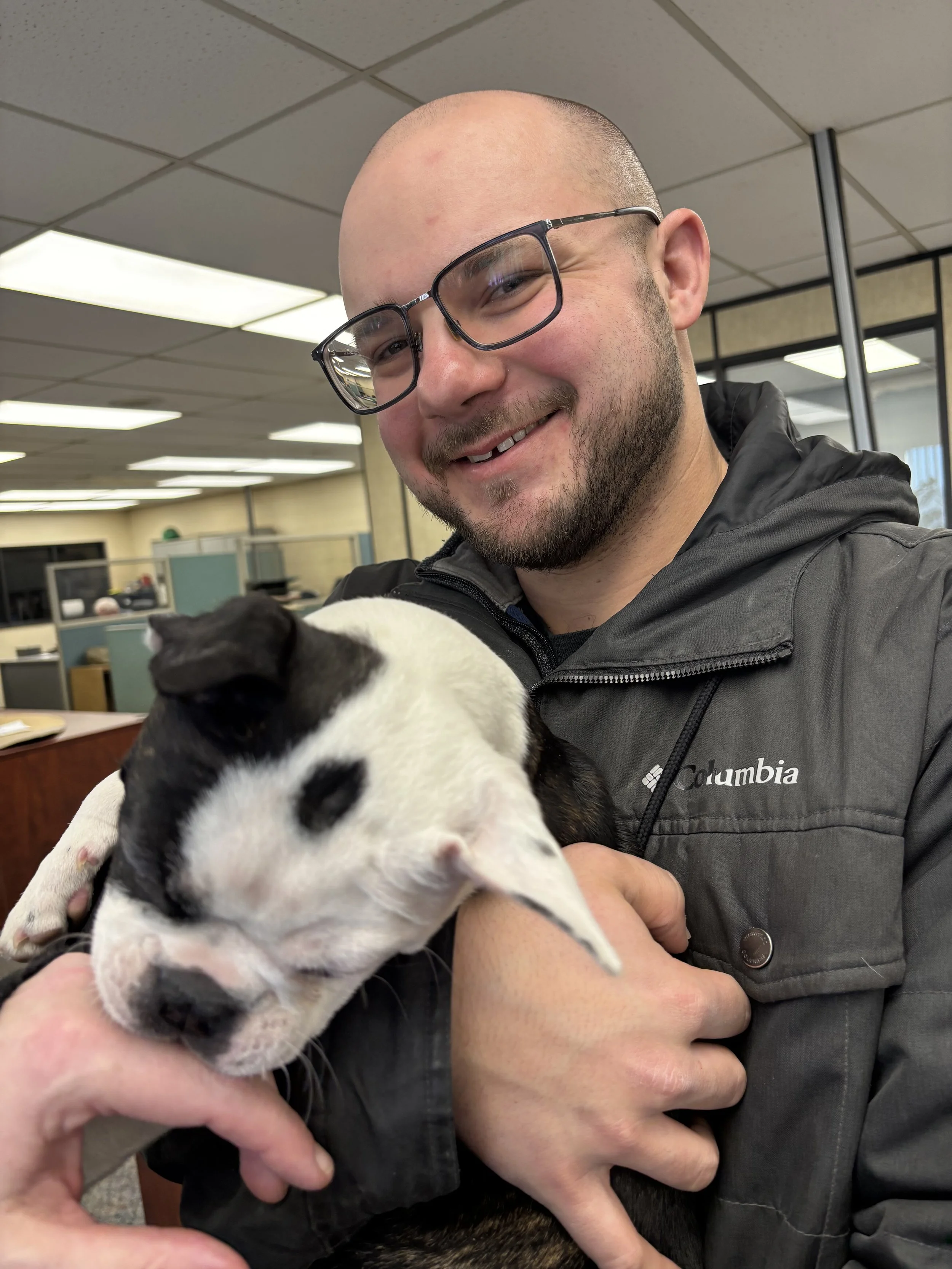
Spotlight: Ross, Education Assistant
Ross’s neurodivergence equips him with powerful pattern recognition skills that help him trace a child’s dysregulation back to its true origin, often spotting the trigger long before anyone else can. He has an intuitive sensitivity to children’s tone of voice, posture, and micro‑ expressions—something colleagues, including SLPs, have noted when they remark on how precisely he reads “that face” or “those eyebrows.”
Ross also recognizes which sensory pathways a child is using in a moment; he recalls watching a child build the same circular pattern in sand over and over, only to gleefully destroy it and rebuild it again.
When Ross copied the pattern and purposely disrupted it, the child immediately‑ fixed it for him—an entry point into connection that came from following the child’s sensory logic. His ability to step into their patterns, decode their behaviours, and understand their sensory intentions makes him a profoundly attuned supporter of neurodivergent learners.
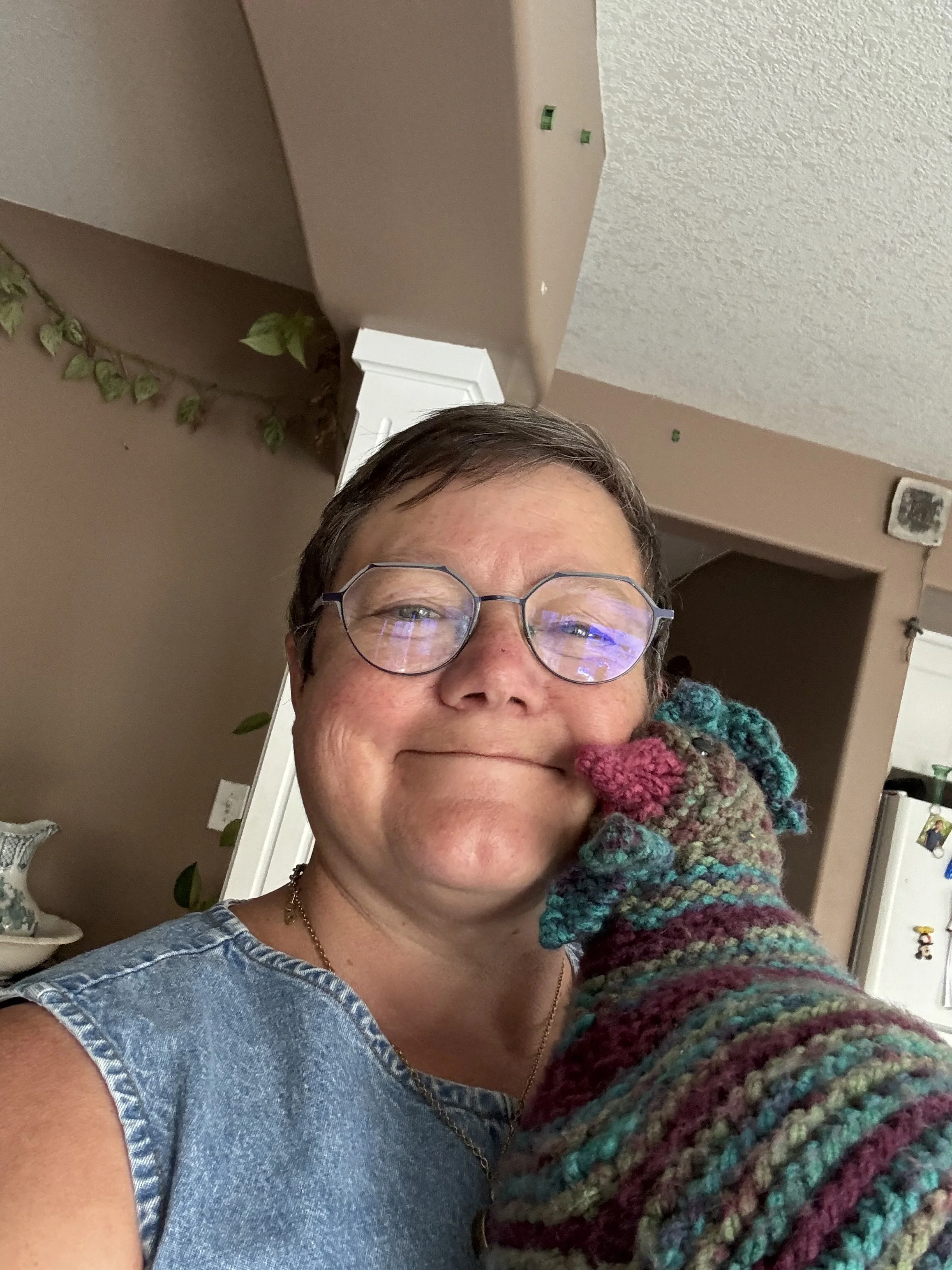
Spotlight: Laurie, Speech Language Assistant (SLPA)
Laurie is a neurodivergent SLPA, and also a parent who raised two neurodivergent children into adulthood. Her lived experience allows her to notice subtle cues in children long before others do—tiny shifts in behaviour, posture, or sensory responses that signal what a child needs to stay regulated. She recalls moments where she pulled a child aside before they fully dysregulated, only to have to later justify her intuition to others who hadn’t seen the early signs. These lived experiences now help her coach staff on recognizing the “pre‑dysregulation tells” in preverbal children so that more educators can intervene compassionately and effectively.
Laurie frequently reminds teams that learning looks different for each child and that they cannot absorb anything if they’re not regulated. She affirms that supporting regulation is not “giving in,” it’s meeting a need.
Her practice is influenced by her own children’s school experiences, including one where her son was praised for sitting still during a test even though he only scored 50% on material he understood. In these cases, we have to ask more of the education system – what are we really testing when we add expectations to children that bar them from learning or demonstrating their knowledge?
In the early years, Laurie uses this story as a reminder that compliance does not equal learning. Whether it’s figuring out that a child can sit at circle time as long as they have a special toy or recognizing that another child hears better when given playdough and space at the back of the room, Laurie approaches each situation with curiosity and flexibility, always searching for the conditions that allow a child’s strengths to emerge.
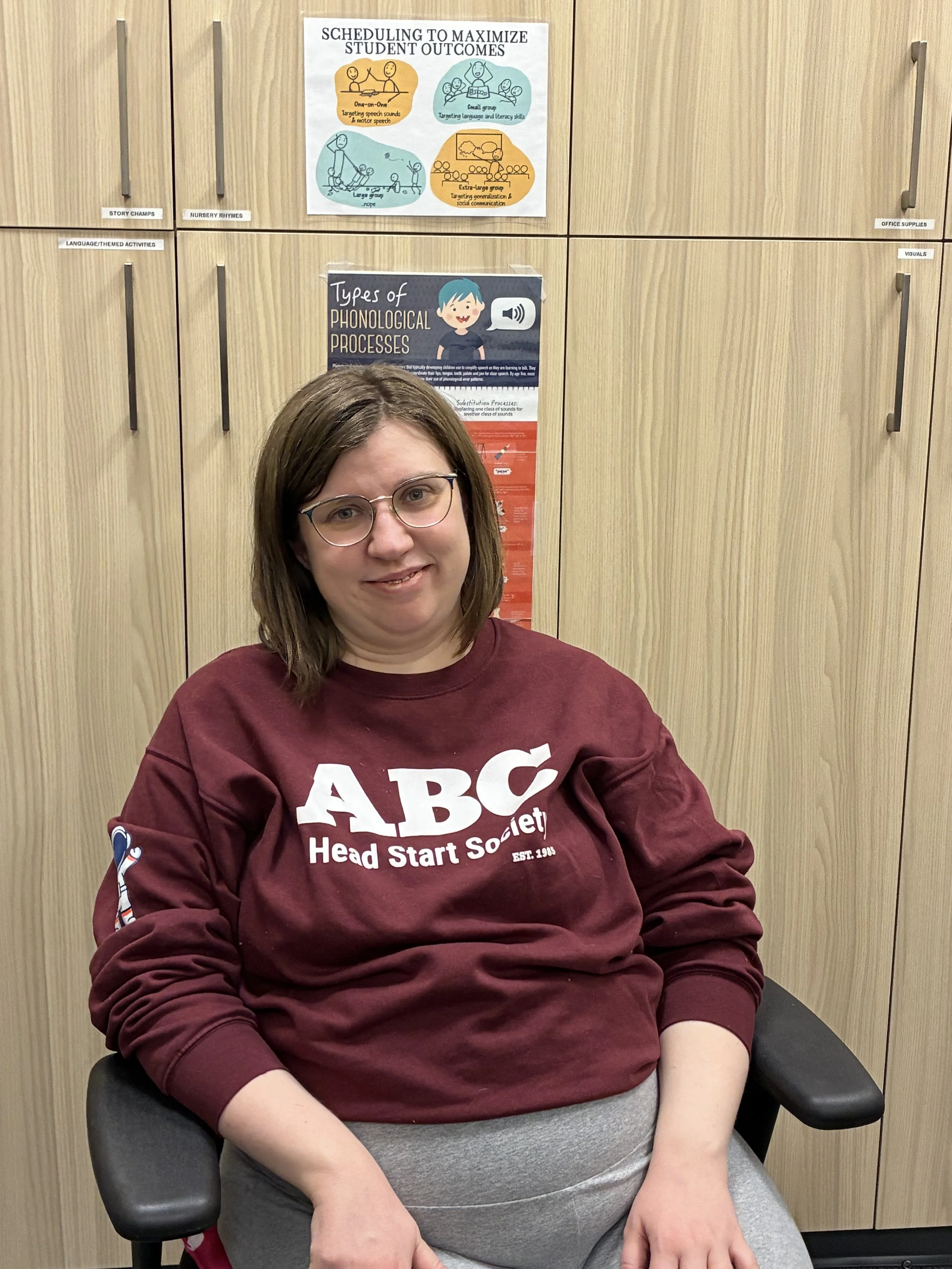
Spotlight: Megan, Speech Language Pathologist
Megan views her neurodivergence as a meaningful difference that helps her bring honesty, compassion, and hope into conversations with families. She openly shares her diagnosis when it can build trust. She may tell parents, “I have ADHD, and I'm not judging your child for showing signs of it. It actually helps me in my adult life, and with support, it has not gotten in the way of my goals”
Megan draws on her experience and that of others in her family to show that neurodivergent adults can and do thrive. She is often reassuring families that support services don’t close doors in the future; they actually open doors to more support now. Megan notices the quiet ways families already support their children—changing diets, adapting routines, explicitly teaching social skills—often without realizing they’re already building a neurodiversity affirming‑ environment out of love.
She also deeply understands that autistic children sense authenticity; if an educator uses a child’s interest as a reward rather than sharing in it sincerely, the child knows. She stresses that educators should never under-estimate a child’s memory. Sometimes children she supported a year earlier seek her out by referencing a shared toy or humming a song they sang together, showing her—without words—how meaningful the connection was. For Megan, these small moments are proof that respect, authenticity, and lived experience shape relationships that last.
While Megan resists framing neurodivergence as a superpower—likening it instead to a difference that has some benefits but also sometimes results in putting oven mitts on the stove and watching them catch fire—she embraces the reality that her way of processing the world can be advantageous, especially when empowering families to see endless potential in their neurodivergent children.
Looking Ahead: Building Strong Foundations Through Neurodiversity
Supporting neurodivergent children from birth to age five is about more than early skills—it is about shaping identity. When children grow up experiencing acceptance, flexibility, and understanding, they learn that they are capable, valued, and worthy exactly as they are.
At ABC Head Start, neurodivergent-affirming practice means creating environments where children are supported in ways that honour how they think, feel, communicate, and learn. It means recognizing that regulation, curiosity, and connection are the foundation for all meaningful learning.
By centering neurodivergent voices in early childhood services—both professionally and personally—we deepen our understanding of children’s needs and strengthen the environments where they grow.
When young children are supported in ways that respect their differences and nurture their strengths, they gain something far more important than early academic skills: they gain the confidence to be themselves and the foundation to thrive throughout their lives.
About the Author
April MacDonald Killins is the Research and Evaluation Coordinator at ABC Head Start, drawing on 17 years of experience supporting children in classrooms across Alberta and shaping education policy and practice.
She is neurodivergent herself, an artist and a published author.
April often writes about social difference and how diversity and excellence are deeply connected.
Sources
Graf-Kurtulus, S., & Gelo, O. C. G. (2025). Rethinking psychological interventions in autism: Toward a neurodiversity-affirming approach. Counselling and Psychotherapy Research, 25, e12874. https://doi.org/10.1002/capr.12874
Izuno-Garcia, A. K., McNeel, M. M., & Fein, R. H. (2023). Neurodiversity in Promoting the Well-Being of Children on the Autism Spectrum. Child Care in Practice, 29(1), 54–67. https://doi.org/10.1080/13575279.2022.2126436
Killins. A.M. 2024. Our gifts: Cognitive differences make us exceptional (book chapter). Derrique DeGagné (Ed.) Weaving Hope Through Our Education System. Peter Lang Publishers.
StEvens, C. (2022). The lived experience of autistic teachers: a review of the literature. International Journal of Inclusive Education, 28(9), 1871–1885. https://doi.org/10.1080/13603116.2022.2041738